Barbie Movie Review
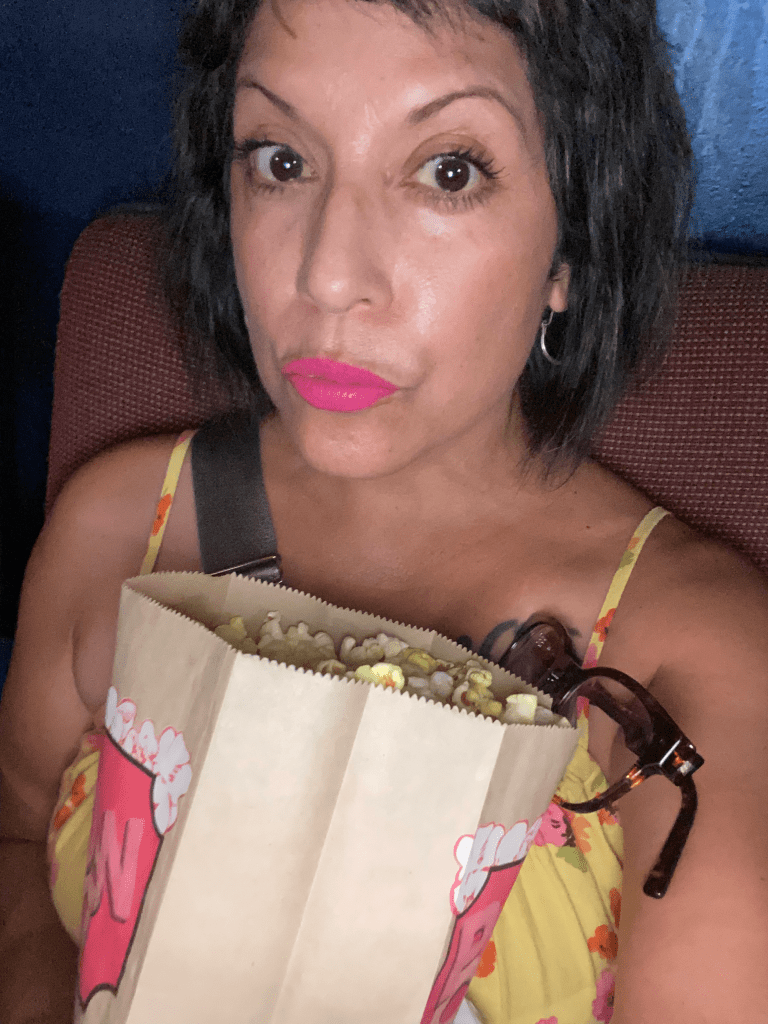
I went to see the Barbie movie by myself after it had been out a few weeks already because all my friends had already seen it or wanted to see it with their daughters. Even though I’m not a big Greta Gerwig fan and have critiqued her movies publicly in the past (based on the trailers and reviews) I expected to like it and I did. I actually liked it a lot and totally plan to see it again when it streams online. I think it was a couple of the Tik Tok reviews by men who were totally blown away and suddenly aware in a new way of the patriarchy shit-show that is all our lives that made me finally buy a ticket, but generally, I avoid movies that are franchises or based on products. Overt capitalism is total buzzkill. I prefer a more subtle capitalism with my art–just let me eat my popcorn in peace.
The opening scene *crunch crunch* was kind of a masterpiece. I’ve totally thought it, but I wasn’t expecting the critique of giving little girls dolls as inculcation of gender roles and the expected ensuing of motherhood, nor was I expecting Barbie’s existential angst which for women is so completely tied to our appearance and fears of sagging skin and decaying bodies. Do you know how seriously I take my skincare routine? Thanks Zoom!
You have to never get old, never be rude, never show off, never be selfish, never fall down, never fail, never show fear, never get out of line. It’s too hard! It’s too contradictory and nobody gives you a medal or says thank you! And it turns out in fact that not only are you doing everything wrong, but also everything is your fault.
–Gloria in Barbie
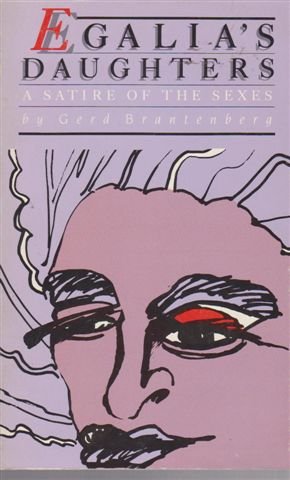
In around 1990, after I started Spitboy, my roommate, Kate Knox gave me the book Egalia’s Daughters: A Satire of the Sexes. She had read it in one of the literature classes that she was taking at SF State. I didn’t, yet, have money to go to school, but Kate had a knack for knowing which books I’d like off her syllabi (these books would often then inspire some Spitboy lyrics). Published by a small publisher in 1977 in Norway, Egalia’s Daughters and Barbie have a very similar premise–don’t worry, I’m not going to imply that Gerwig borrowed from Egalia’s Daughters. The society in which the story takes place is a matriarchy, men are called menwim 🤣 and must wear a penisholder because to not do so would be indecent (*gasp* allowing one’s parts to just flop around), and they must protect themselves from attacks by abusive wim.
It’s great satire designed to highlight treatment of women as second-class citizens and the folly of a belief in hierarchies created solely for the sake of grabbing and holding onto power. It and 1984, The Handmaid’s Tale, and so many other dystopian/utopian satires are why I’m a huge fan of the genre. Besides all the ways in which dystopian literature is totally punk rock, the other reason I am a huge fan is the ways dystopian authors reference each other. I think of dystopian literature as a conversation. George Orwell was in conversation with Yevgeny Zamayatin and We, Katherine Budekin and Swastika Night, and Aldous Huxley and Brave New World, and Margaret Atwood was in conversation with Orwell and Zamayatin, and Tehor Kay Mejia, author of We Set the Dark on Fire, was in conversation with Atwood, and so on and so-forth. For writers and lovers of satire, it’s nearly impossible to read a dystopian novel and not imagine what one’s own dystopian society would be. After reading 1984, The Handmaid’s Tale, and Super Sad True Love Story, I knew that my dystopian novel would be about Mexicans, near future Mexicans, and my novel’s premise is an off-shoot of George Orwell, Margaret Atwood, and Gary Shtyngart’s novels, in the way Orwell’s is an offshoot of Zamayatin, Huxley, and Burdekin’s novels. Dystopian novels are conversant homages to works that came before, inspired new works that bring about new conversations.
As I pointed out in my 2017 critique, since there are way too many similarities between the two movies to be a coincidence, Gerwig’s Lady Bird should have been described as an homage to Real Women Have Curves and not simply a story somewhat rooted in Gerwig’s own biography, but it might have been difficult to do that after having borrowed so closely from a movie about a Chicano family. Barbie, however, is a homage of sorts. And as a true disciple of Orwell, I believe that if you love something–especially when you love it–that something should be critiqued. In this case, Gerwig agrees, critiquing Mattel’s Barbie for spreading “unrealistic physical ideals, sexualized capitalism and rampant consumerism,” a critique that, according to the NY Times Magazine, made the Mattel company very uncomfortable, but in the end they gave the critique the go-ahead because, “They wanted Gerwig, with her indie bona fides, feminist credentials and multiple Oscar nominations, to use her credibility to make this multibillion-dollar platinum-blond I.P. newly relevant, delivering a very, very, very pink summer blockbuster that acknowledges Barbie’s baggage, unpacks that baggage and, also, sells that baggage.” The NY Times Magazine review does a great job of focusing on the paradoxes that made it possible for Gerwig to co-write and direct a movie about the paradoxical nature of Barbie’s feminist icon status and the capitalism at play, so I’ll go back to focus on getting to my real point.
I’ve thought about this movie a lot since I saw it, and that’s how I define “good” – when a movie continues to haunt or resonate the way a good book can after I’ve read the last page and put it away on the shelf.
When I first left the theater, the first thing I thought was how the women’s issues raised in the move were not news to me. I’ve been writing about these issues most of my life, but I could see how in this movie format, how the depictions of the patriarchy through the role reversal landed for many men in a way they never have and it explained the Tik Tok reviews that made me finally buy a ticket.
Men look at me like I’m an object, girls hate me. -Barbie
I also thought about my earlier critiques of Gerwig, and I felt like a teacher who is lucky enough to have the same student two or more semesters in a row and gets to see the student come into their own voice as a writer, the student who always impressed you in some ways, but who you get to see create something super fresh and creative like nothing you’ve quite seen before. And I thought about women in Hollywood, how few women get work as directors, or movies about women, women’s issues, or women talking about anything other than men. Familiarizing yourself with the facts about female representation in Hollywood made what Gerwig pulled off with Barbie quite remarkable and to her credit, she cast Honduran American actor, America Ferrera the star of Real Women Have Curves even after The New York Times published an article by Monica Castillo titled ”Why Real Women Have Curves Never Got It’s Lady Bird Moment,” which addressed the RWHC/Lady Bird controversy and linked to my 2017 critique which was published by Latino Rebels. And Ferrera who plays Gloria in the movie has the best monologue, the monologue which feels as though it contains so many of the things women in Hollywood, women like Gerwig, have probably wanted to say out loud themselves.
You have to be thin, but not too thin. And you can never say you want to be thin. You have to say you want to be healthy, but also you have to be thin. You have to have money, but you can’t ask for money because that’s crass. You have to be a boss, but you can’t be mean. You have to lead, but you can’t squash other people’s ideas. You’re supposed to love being a mother, but don’t talk about your kids all the damn time. You have to be a career woman but also always be looking out for other people.
–Gloria in Barbie
Of course others have and will make critiques of Barbie, valid critiques about other kinds of representation that missed the mark like in this Forbes critique by Virgie Tovar, who makes this great point: “If the new Barbie movie is about addressing and righting past wrongs – and I think it is – the central plotline doesn’t tackle the right one, the big one. When it comes to Barbie, it’s not toxic masculinity that needs to be reckoned with. It’s Barbie’s long-time correlation with negative body image and lower self-esteem in girls.” In some way, I feel like the movie does this, but fair point, probably not enough given that no human could ever survive with dimensions of the original Barbie body and today’s curvy Barbie is just a size 6-8, my size in sewing patterns. Still, for me, the jabs at toxic masculinity were super satisfying, like when Ken says, “Barbie, why didn’t you tell me about the patriarchy” or, “Let me play guitar at you,” 🤣🤣 as he’s about to sing “Push,” by Matchbox 20, a song that I hope they have retired the way Pat Benatar retired her massive hit “Hit Me With Your Best Shot.”
Given its massive appeal, there will, however, likely be a follow-up to the Barbie movie and a lot more plastic toys. I hope I’m wrong because if there is, it won’t likely deal with the body image issues or anything any other issues missed in the current movie, and I hope Gerwig moves on to a different project. You’d think that the success of this movie would make that possible.
Posted in: Reviews

 Michelle Cruz Gonzales
Thank you for writing a meaningful comment on the Barbie Movie. You convinced me to see it.
LikeLiked by 1 person